The Heart of an Analyst Some Tools and Techniques of Basic Mathematical Analysis
4 techniques to continue your tool at the tiptop

Technology loves the new: the hot new app, the startup, the disruptor. But that obsession with what's fresh sometimes blinds usa to the advantages of mature technology and companies: a user base that's familiar with your product, a feature gear up honed by years of iterations, the resources that come from running at a profit. The trick is to maximise the advantages of mature engineering science while scraping off the barnacles that accept accumulated on your hull over the years.
Every bit chief product officer at Adobe, it's a challenge myself and the rest of the Creative Cloud squad face up every mean solar day. We take advantages that almost startups would give up a major round of funding for: millions of customers worldwide; a feature set that includes near everything creative professionals demand; plugins and partnerships that extend our apps' effectiveness.
Simply barnacles – we have a few of those, likewise. Some of our apps are complex and the learning curve can be steep. While more than of our apps are going mobile, some are however desktop-just. And over many years of adapting code for different operating systems, hardware setups, and 3rd-party plugins, bugs and performance problems crept into our products.
The Artistic Cloud squad is attacking those issues aggressively. I'd similar to share some of the lessons we've learned along the style.
Non signed up for Creative Deject? See our roundup on the best Adobe CC deals here .
Lesson #1: Empathy is everything
To ameliorate your products, you have to listen closely to your customers, hear what frustrates them, what confuses them, what they wish they could do with your tools. And look closely at the data to get an overall view of users' experiences.
Sometimes, that requires learning new skills. We've recently been training more members of our product team to engage directly with customers on social media and so they can hear first-hand about both the pleasures and frustrations of using our tools. We also pay attending to media stories about our products and, peculiarly, the reader comments attached to those stories. This feedback can sometimes be hard to read, but it's all valuable.
If you don't put in concentrated endeavour, you'll hear but the loudest voices amidst your customers
Case in signal: When nosotros launched a new version of Photoshop on the iPad, some Photoshop veterans were disappointed that it didn't include all their favorite tools and they permit us know in online comments and reviews (read CB'south Photoshop for iPad review and Photoshop 2020 review). We learned that we needed to be much more transparent about our intentions for Photoshop on iPad and we committed to a public roadmap for calculation some of the most-requested additional features.
Effectively interpreting the data from your applications is an acquired skill, besides. The problem today is never having too little information – it'due south having too much. We've investigated and experimented to figure out which information points in the welter of information we have are most telling about our customers' experiences.
The virtually important thing about empathy is remembering that information technology is piece of work. If you don't put in concentrated endeavour, you'll hear only the loudest voices among your customers and that can lead you in the wrong direction.
Lesson #2: Pay attention to the First Mile
The Starting time Mile of a product is everything that a new user relies on to get oriented: the welcome tour, the default choices, the explanatory copy, and more. Those elements are essential to newcomers' success and satisfaction with your production, then information technology'southward bewildering that the First Mile is often given and so petty focus.
When we looked at the outcome of our products' steep learning curves, we recognised two things. Offset, some of our tools are sophisticated, professional-grade products that will never be uncomplicated to choice upward. But, second, we were inadvertently making things worse by not putting enough endeavour into the First Mile.
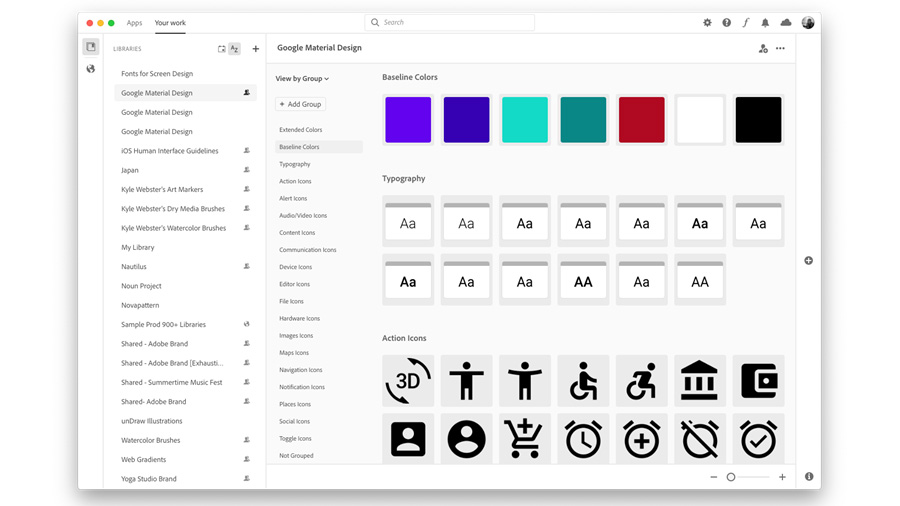
Over the past couple years, nosotros've focused on the Outset Mile and we're seeing some encouraging results. One great example is Artistic Cloud Libraries. These collections of brushes, colour schemes, stock photos, and more are a great mode to organise your own work and to create collaboratively with others. They weren't used often enough, though, simply because they were hard to find and work in.
We rolled out a new version of our Creative Cloud Desktop application that brings Libraries front-and-center and makes it piece of cake to meet their benefit. And we've seen a big spike in usage.
Examine all the things you take for granted and ask whether they'd be as obvious to someone who's never seen it before
We've also recognised that sometimes a customer just needs to learn a new technique – they know that their photo is too flat, but they don't know how to fix the problem. In Lightroom, we've introduced new interactive tutorials from master photographers that guide users footstep-past-step through mutual tasks, like balancing the light in a sunny portrait.
Desire to work on your own First Mile? Showtime past examining all the things yous take for granted about your product and ask whether those things would exist as obvious to someone who'due south never seen information technology before.
Lesson #3: Be prepared to rethink everything
When you beginning build a product, you build it based on the assumptions and technical limitations of the time. As time goes past, those baseline assumptions alter, and y'all have to make sure your product changes along with them.
When we started building artistic tools, but desktops were powerful plenty to handle complex creative projects and local storage of files was the merely option. Now, of class, mobile hardware has get so powerful that devices like the Apple iPad and Microsoft Surface are fully capable of running complex creative applications (see CB'due south pick of the all-time drawing apps for iPad).
Production leaders should call up almost expansion... as an opportunity for reinvention
The same is increasingly true for web browsers and the potential for web apps to generate industry-grade output. And network connections have get and then fast that storing big files in the cloud is non a problem.
We're working hard to take reward of these developments with new products and features that expand Creative Cloud's footprint, including Deject Documents, creative files that live online to arrive easy to collaborate and create anywhere; live co-editing of projects in Adobe XD, our interface design and prototyping tool; and Adobe Spark spider web apps that let you create social posts, videos, and webpages in a browser. And, of grade, we launched the first version of Photoshop on iPad.
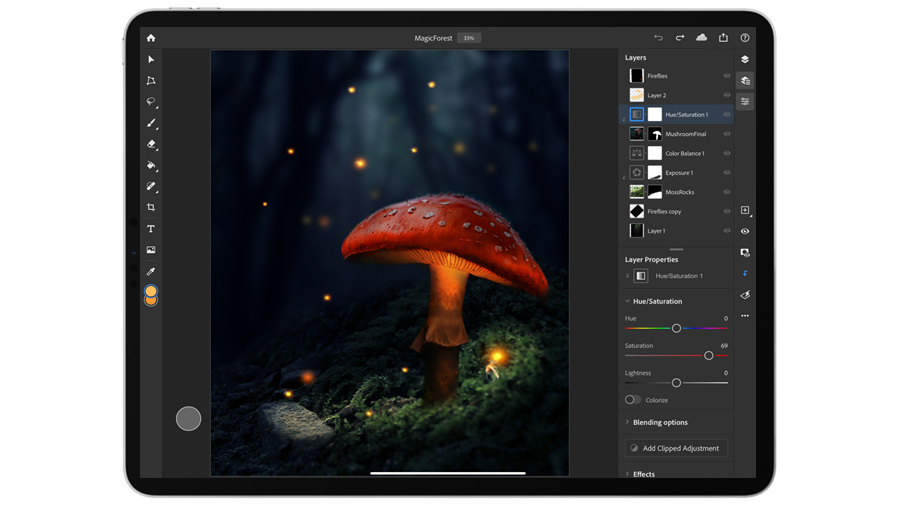
We've learned that large changes like that don't simply let you extend your product to a new platform. They give y'all an opportunity to engage new types of customers and completely rethink the manner your product works. Building Photoshop for a mobile, bear upon-oriented device helped the states completely reimagine the interface of this about 30-year-sometime application, making it more than direct and intuitive.
And introducing Deject Documents doesn't just requite people a new mode to store their projects. Information technology fundamentally changes the way people create and collaborate. Cloud Documents get in easy to start a project on one device, then cease it on another, or share projects with others to collaborate on or review.
We're applying those lessons equally we develop additional creative tools for mobile platforms. Terminal summertime, Adobe Fresco, our new drawing and painting app, debuted on the iPad and nosotros quickly brought information technology to the Microsoft Surface Pro X and Wacom MobileStudio Pro (read CB's Adobe Fresco review). Fresco is as well fully compatible with Photoshop on both desktop and iPad. We're currently developing an iPad version of Adobe Illustrator, a version that will also exist interoperable with cardinal Creative Cloud apps.
Product leaders often think virtually expansion to a new platform simply as an opportunity to grow their markets. We should besides think about it every bit an opportunity for reinvention.
Lesson #4: Don't lose sight of performance
All of your new features and other product improvements won't mean much if your tools aren't reliable and fast. No slice of software is perfect, but users have a baseline expectation for stability and functioning and if you don't run into it, they will wait elsewhere.
Through listening to our customers, nosotros realised we have more than work to do to meet and exceed their expectations. To attack the issues, we've fundamentally changed how nosotros build products. We've brought in new engineering leaders with fresh perspectives. We've fix ambitious goals for reliability and performance. And we've significantly evolved our internal testing procedures and sped up our release schedules to apace squash bugs.
With mature technology platforms, you have a responsibility to ensure that your products remain accessible and loftier-performing
We're starting to see existent gains in both reliability and speed. In Photoshop, creating a new certificate, a process that used to accept as much as six, finger-drumming seconds is now virtually instantaneous. Deject Documents, after a rocky start, are now much more than reliable. And you can piece of work smoothly and fluidly with literally hundreds of assets in Adobe XD.
At that place are then many benefits to working on products like Creative Cloud with a legacy and a loyal base of users, and I know that's true of many mature technology platforms. With those benefits, though, comes responsibleness. A responsibleness to ensure that your products remain accessible and high-performing. And a responsibility to never rest on your laurels and always wait to the future.
Read more:
- The 24 all-time Photoshop plugins
- The 13 best alternatives to Photoshop
- The 6 all-time laptops for Photoshop in 2020
Related articles
Source: https://www.creativebloq.com/features/4-techniques-to-keep-your-tool-at-the-top
0 Response to "The Heart of an Analyst Some Tools and Techniques of Basic Mathematical Analysis"
Postar um comentário