Shorten Folder Name for Upload on One Drive
This article focuses on administration and direction exclusively for OneDrive for Business. Nosotros will cover advice and best practices from my all-encompassing experience working with service ideal for system admins and those actively working with it on a daily ground.
What is Microsoft OneDrive?
Microsoft has two different, but similar services called OneDrive, both of which offer cloud file storage for users. A free version of OneDrive is available to everyone and is often called the "consumer" version. The business version is "OneDrive for Business concern" and requires a subscription to Microsoft 365 or Office 365. Both look a lot alike but are managed very differently. To add to the mix, Microsoft frequently refers to OneDrive for Business organization as only "OneDrive" in their documentation and fifty-fifty in the UI.
Note: I may refer to OneDrive instead of OneDrive for Concern from time to time in this commodity for the sake of brevity, simply I always mean OneDrive for Business unless otherwise stated.
OneDrive for Business has company-broad administration in heed. A service ambassador tin command the deployment of the synchronization app, network operation, and many other settings. With OneDrive (consumer), there is no management framework. The private using the service controls their settings.
Where Should Users Save Files?
OneDrive for Business makes information technology very easy to share files with others, but if you find yourself sharing lots of files, it is recommended to employ Teams or SharePoint instead. Teams and SharePoint are simply better for collaboration. For instance, with OneDrive, you tin can't check-in and check-out a document. Also, in Teams, whatsoever certificate yous upload to Teams is available to the entire Squad by default, whereas documents yous upload to OneDrive are individual by default. Also, in Teams, a conversation about a document is shared in a Teams channel rather than via email. The full general guidance is if you are working on a file without others involved use OneDrive for Business. If you need others involved, apply a more collaborative service – Teams or SharePoint.
OneDrive for Business uses SharePoint Online every bit Service
As the service administrator, one of the most important concepts to master is that OneDrive for Business is a special purpose SharePoint document library created automatically for every user in your visitor. When a user is assigned an Office 365 or Microsoft 365 license, the services automatically create a personal OneDrive for Business document library.
The URL for OneDrive for Business organization is formatted as follows:
https://<company base of operations name>-my.sharpoint.com/personal/<user-id>
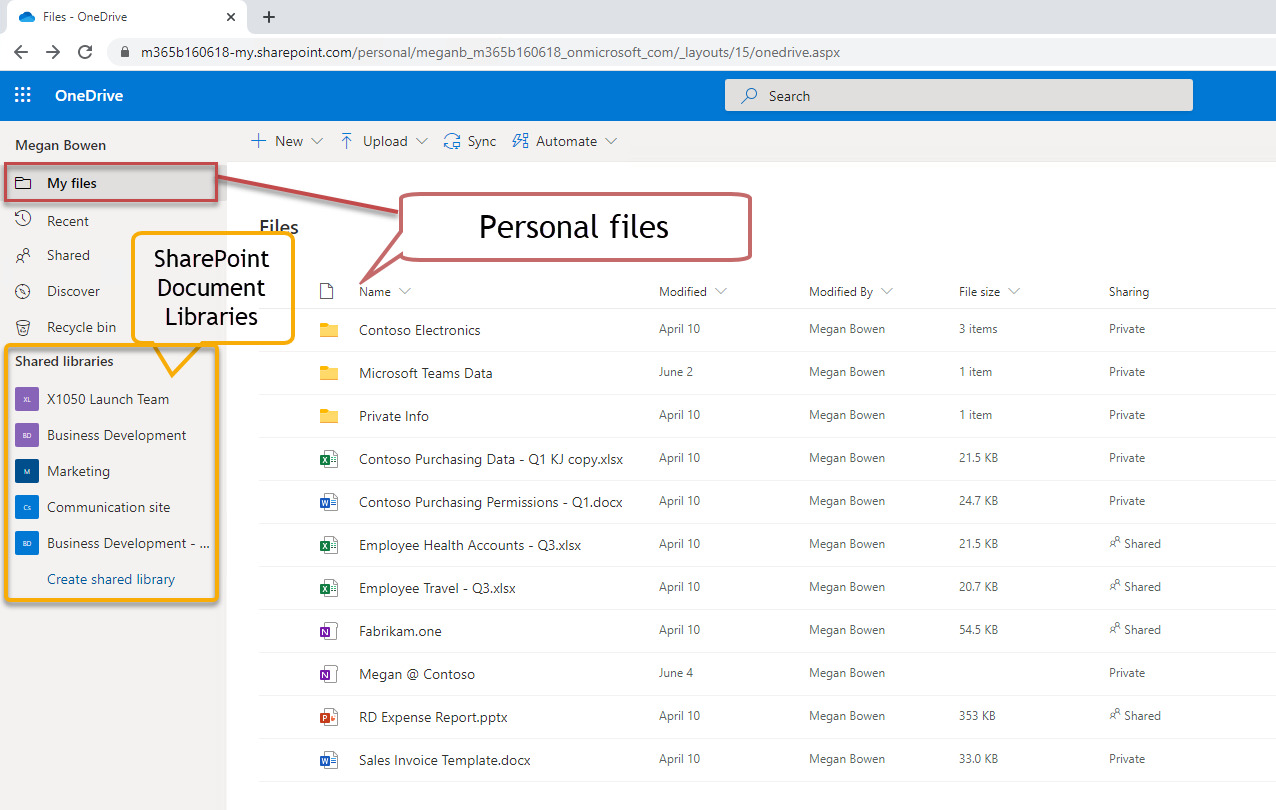
The landing folio (shown above) for OneDrive for Business shows "My Files" which are your files. You tin besides navigate from here to any SharePoint asset, including SharePoint Document Libraries, files hosted for Teams, or other SharePoint content.
Now that you know OneDrive for Business is using SharePoint under the hood, the post-obit guidance makes sense:
To manage the OneDrive sharing settings for your organization, use the Sharing folio of the new SharePoint admin centre, instead of the Sharing page in the OneDrive admin heart. It lets you manage all the settings and latest features in one place.
In this way, settings related to file sharing on SharePoint are aligned with those for OneDrive for Business (and Teams, which also uses SharePoint as a file store). OneDrive picks up many features from SharePoint, such as the ability to practise File Restores, Restore a previous version of file, and synchronize files to your desktop.
Piece of cake Anonymous Access
Ane main reason OneDrive for Business organisation is well-liked is that it's and so like shooting fish in a barrel to share a document with anyone. You can send someone a URL to a document and relax. It just works, and you won't hear the dreaded "I tin't open the document" (which is all too mutual and a huge productivity sink).
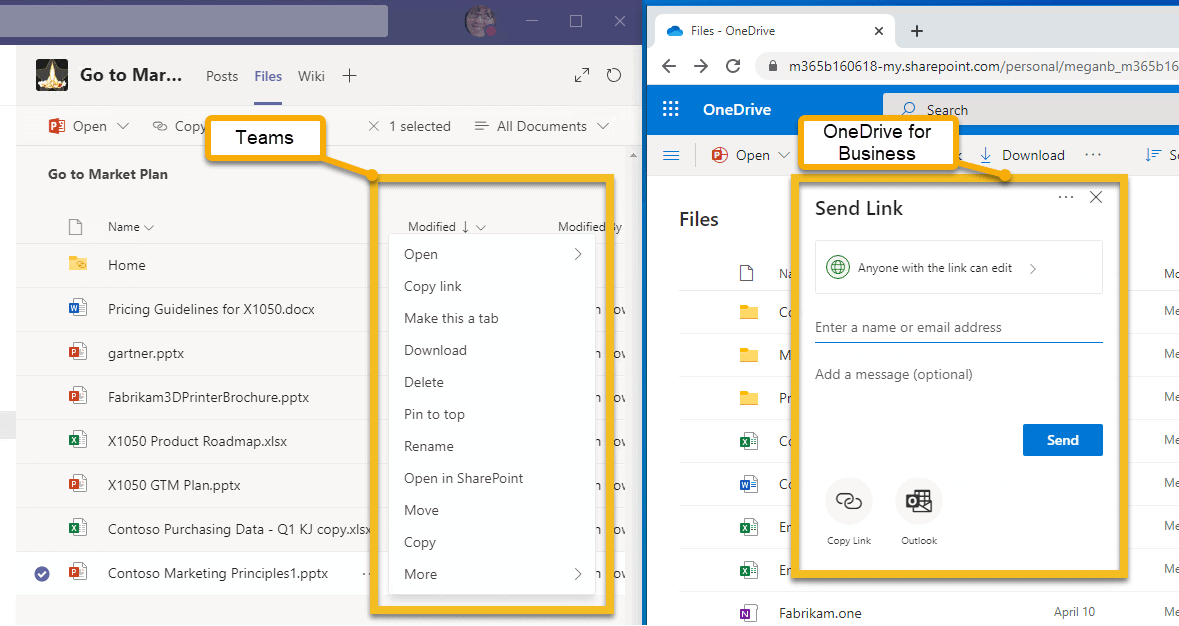
The screenshot below exemplifies my point. What's being shown is the side-by-side sharing feel in Teams vs. OneDrive. Take annotation! There is no Share option in Teams. You lot tin can copy the link to the file, but you lot must know if the user you lot send it to has rights to view the document in the Teams library. In OneDrive for Business concern, however, there is a Share pick that allows you to send a URL to anyone. This is called Anonymous Admission and is one of the primary reasons users share from OneDrive rather than Teams.
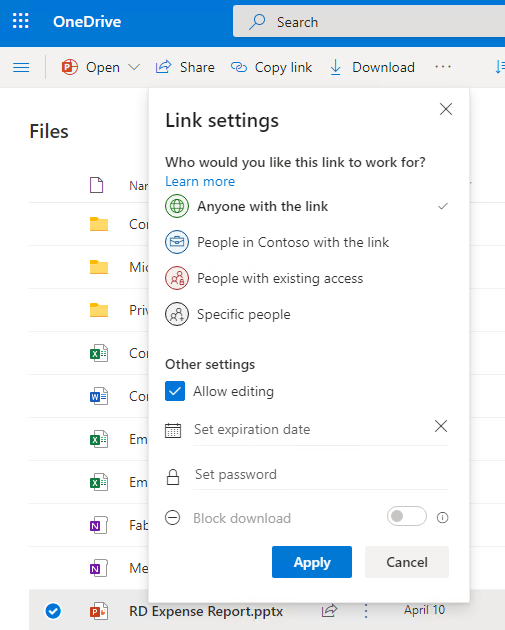
Also, in OneDrive, if you click on Anyone with the link tin can edit, y'all tin farther refine the Sharing options.
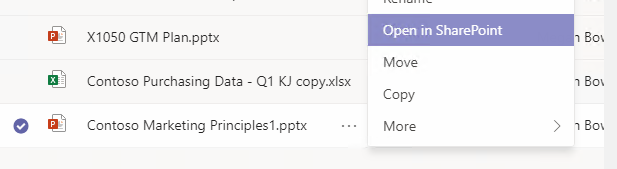
As a side notation, users frustrated by Teams' lack of sharing controls tin easily open a document or folder in SharePoint instead of Teams (equally shown below). In SharePoint, you can share the file with anyone simply like in OneDrive. There'southward no need to copy a file in Teams to OneDrive to share anonymously. Just open up information technology in SharePoint instead!
<>Decision-making Default Permissions
Many businesses prefer to command who tin can open company documents. Y'all can change the default settings in the OneDrive assistants center, but let'south follow Microsoft's communication to use SharePoint assistants instead.
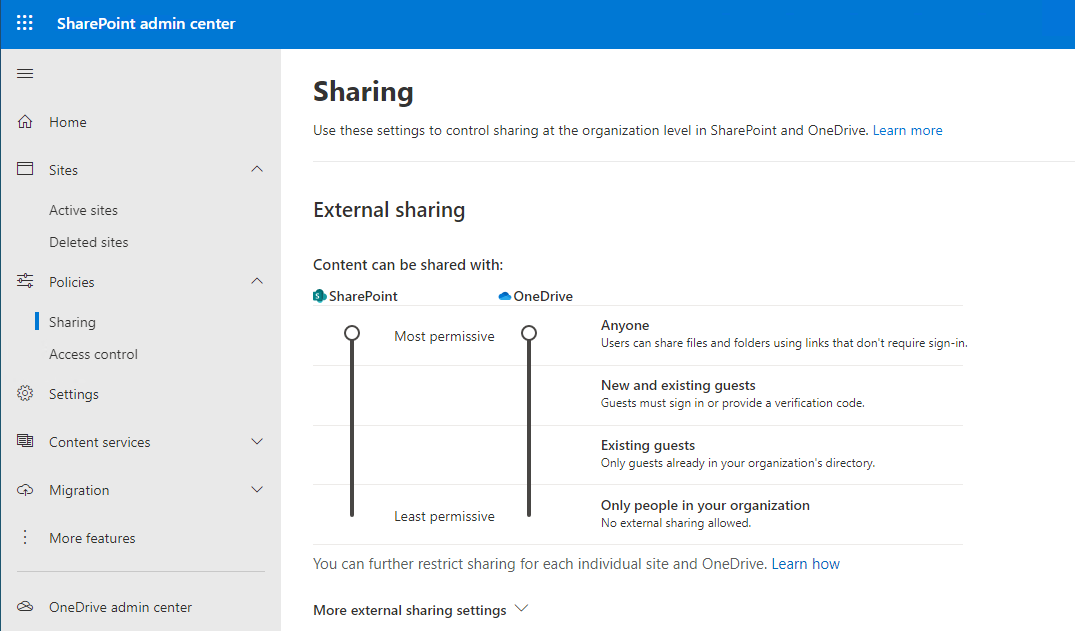
There are split up controls for External Sharing for SharePoint and OneDrive, ranging from Merely people in your Arrangement to Anyone. Yet, what a static snapshot does non reveal is that the OneDrive settings cannot exist more permissive than SharePoint. If yous lower the permission on SharePoint, the permission also lowers on OneDrive. OneDrive can be more than restrictive than SharePoint but never less restrictive. Since SharePoint hosts OneDrive files, this makes sense.
These settings are company-wide. Let users know before y'all make changes to global settings that cause changes in expected behavior. You Volition hear from them, and information technology by and large won't be a happy face emoji.
When invitee users are needed, as they oftentimes are, consider securing the environment with the guidance provided past Microsoft in the documentation page titled Create a secure guest sharing surroundings.
Savvy admins can control sharing using options available when yous click on More external sharing settings on the same screen shown above:
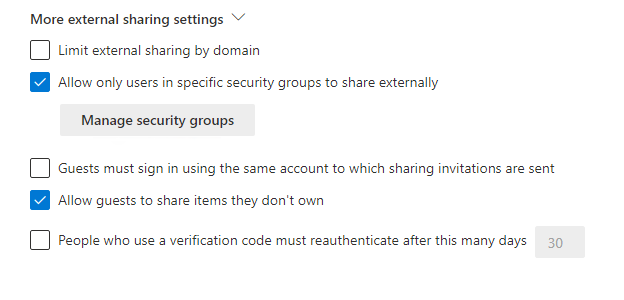
The choice Limit external sharing past domain lets you allow or deny sharing to a detail domain. This can be a dandy way to go when you want to constrain sharing to a specific set of partners or external resource.
Permit merely users in specific security groups to share externally lets yous control who can share files with people outside your organization. A security group is an Azure AD object that is more often than not a collection of users and other groups. Later populating the security group with users, you lot tin assign permissions and policies to the group, such every bit granting the group admission to a SharePoint site, a mailbox, or forcing members of the grouping to apply ii-factor authentication.
Consider the following scenario. Marketing is involved with a lot of external sharing, so nosotros want to enable sharing for members of Marketing but deny everyone else, AND nosotros don't want to take to make adjustments every fourth dimension someone moves into or out of marketing.
To illustrate how this can be achieved with security groups, I created a security group in Azure AD named Marketing-Org and added four users. Every bit employees come and go, members of marketing are added to and removed from this group. (If you haven't created security groups in Azure AD, it's straightforward.)
Side by side, (shown below) I created another security group chosen External-Sharing.
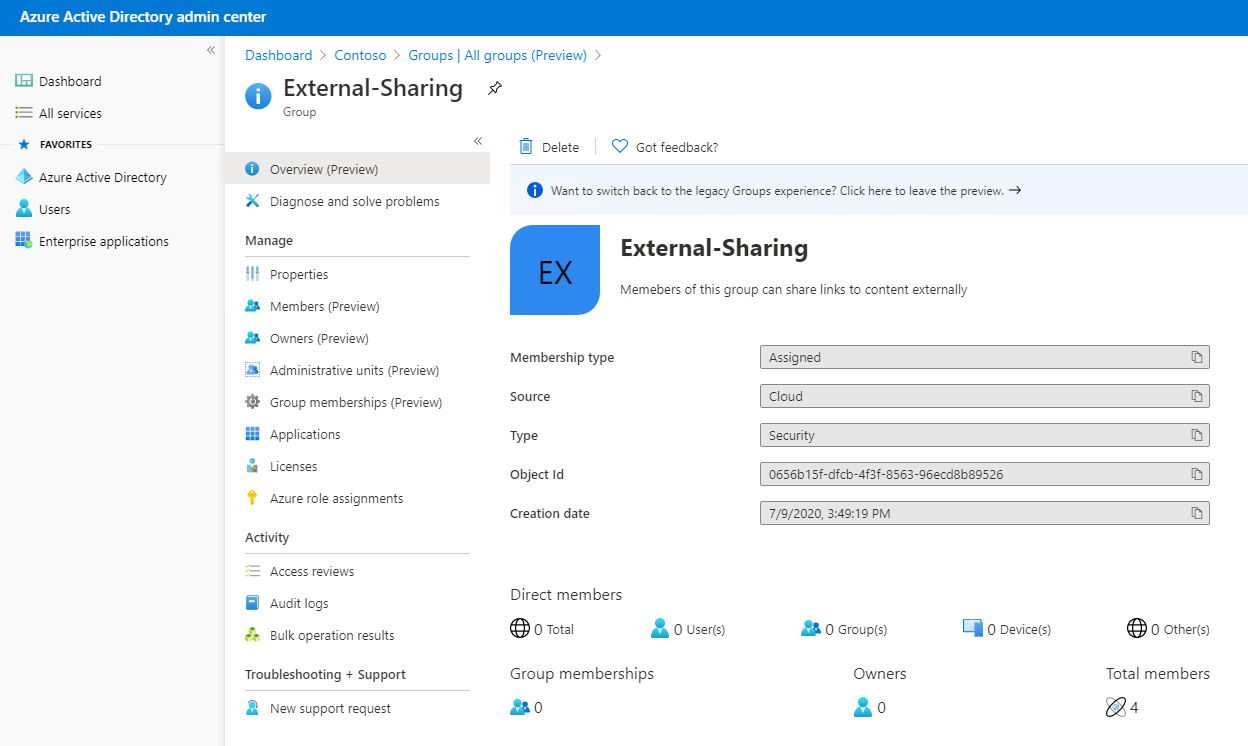
Security groups tin can accept other security groups as members! By adding Marketing-Org to External-Sharing, the users in Marketing-Org automatically inherit External-Org permissions and policies
Subsequently that, I assigned the sharing permissions to the External-Org grouping. Returning to the SharePoint admin heart Policies->Sharing->More external sharing settings-> Allow just users in specific security groups to share externally. Then, past clicking on Manage Security Groups (shown beneath), I added the External-Sharing group and set them so they can share with Anyone. To limit the ability of everyone else, I added the congenital-in security group Anybody except external users and set them to share with Authenticated guests only.
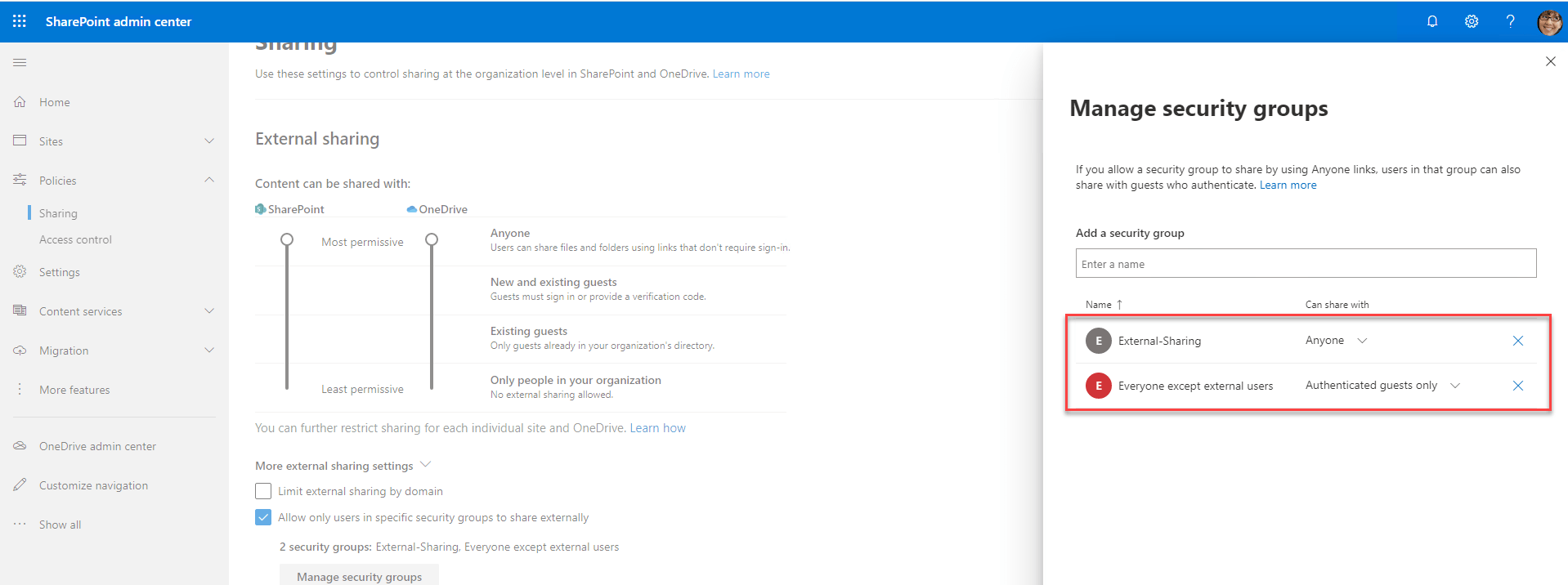
In this way, everyone in the company tin simply share with authenticated guests, whereas only the members of External-Sharing can share with anyone.
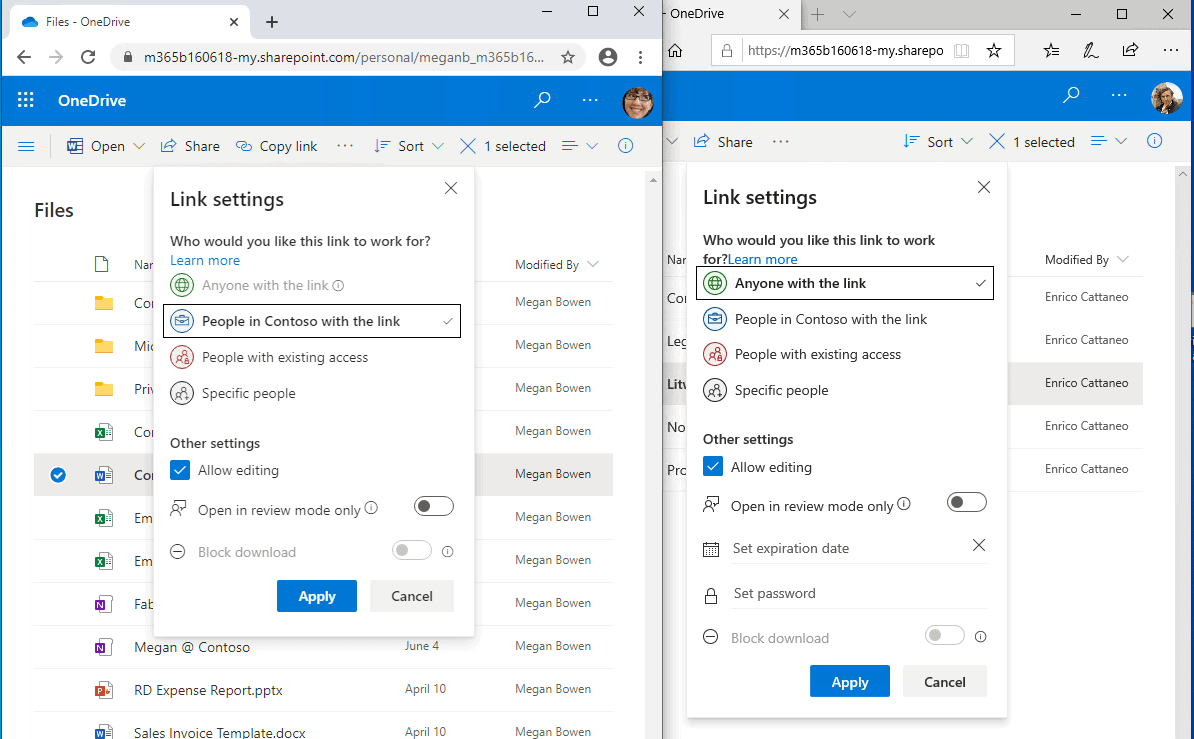
The screenshot below shows the result. The user on the left is not a member of the External-Sharing group (the Anyone choice is grey and cannot exist selected). However, the user on the right can.
One time configured, constructive administrators tin manage membership of the security groups using PowerShell with the Add-AzureADGroupMember and associated cmdlets.
Storage space per user
Nigh Microsoft 365 and Function 365 plans come with 1TB of storage per user for OneDrive. If there are more than 5 users on a program, 1TB tin can be increased past administrators to 5TB. Y'all can even go to 25TB on a user-by-user ground by filing a support ticket with Microsoft.
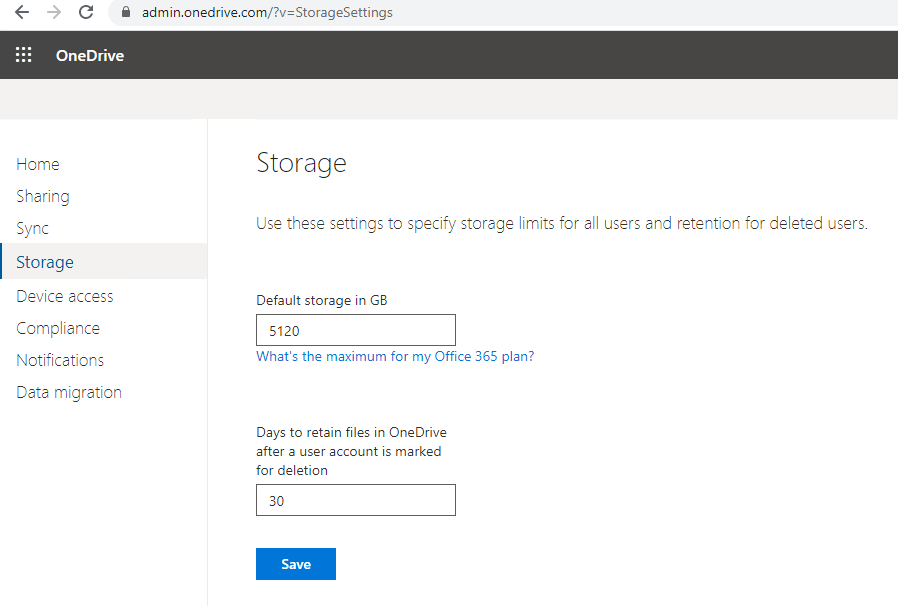
To increment the storage limit for all users, browse to the OneDrive assistants console, and select Storage. Change the setting from 1024 to the new limit. Shown beneath is updating the limit to 5TB. In that location are no additional charges for the increase in chapters.
A global or SharePoint admin can modify storage quotas with PowerShell after you connect to SharePoint using the SharePoint Online Management Beat and run the post-obit command:
Fix-SPOSite -Identity <user'south OneDrive URL> -StorageQuota <quota>.
You have to construct the OneDrive URL from the visitor name and user name, as mentioned before. So, find the user proper name from the list of active users in the Office or Microsoft 365 admin heart.
For <Quota>, enter a number betwixt 1024 (1MB is the minimum) and 5242880 (for 5 TB). Values are rounded up. 1TB is 1048576.
Every bit of this writing, OneDrive allows files upwardly to 100GB.
Request Files
In some scenarios, you lot may desire to collect files from others, rather than send files to others. OneDrive for Business makes this easy with the Request Files feature. With this feature, users can transport an email asking others to upload content to a specific binder.
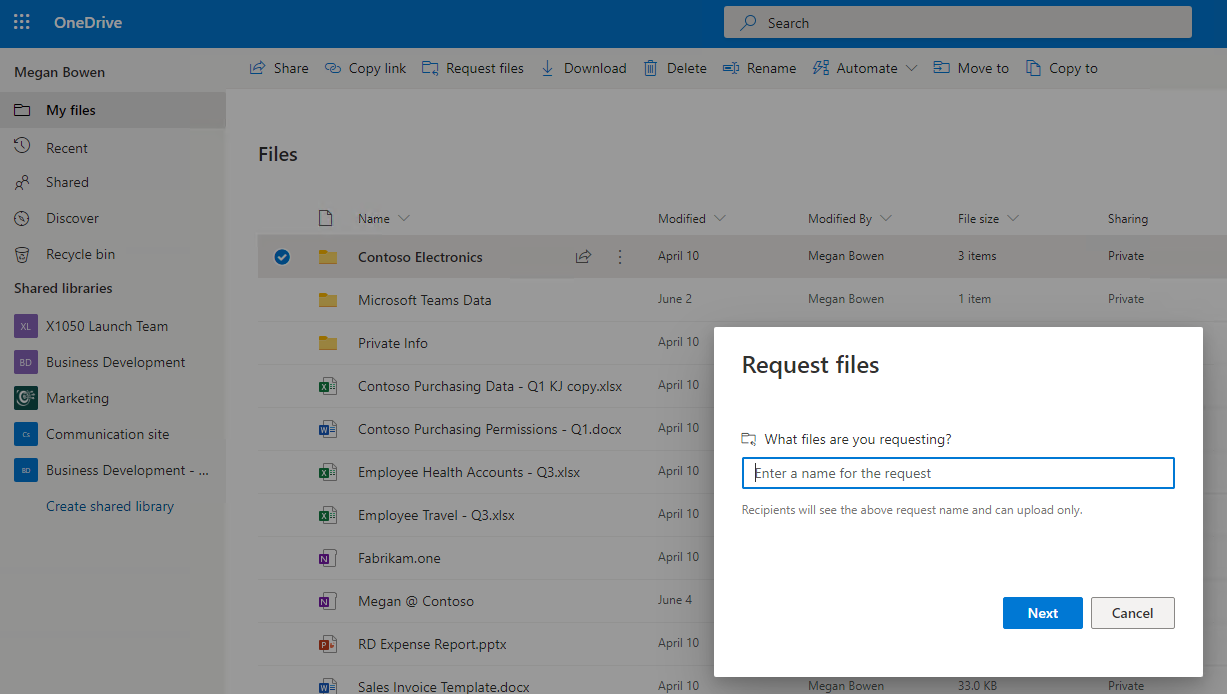
To set a asking files e-mail, in the OneDrive UI, select a folder, click on the ellipses (…), and click Request files. Y'all will see a window similar to the one shown beneath.
After clicking Next, you volition see the Ship file asking window:
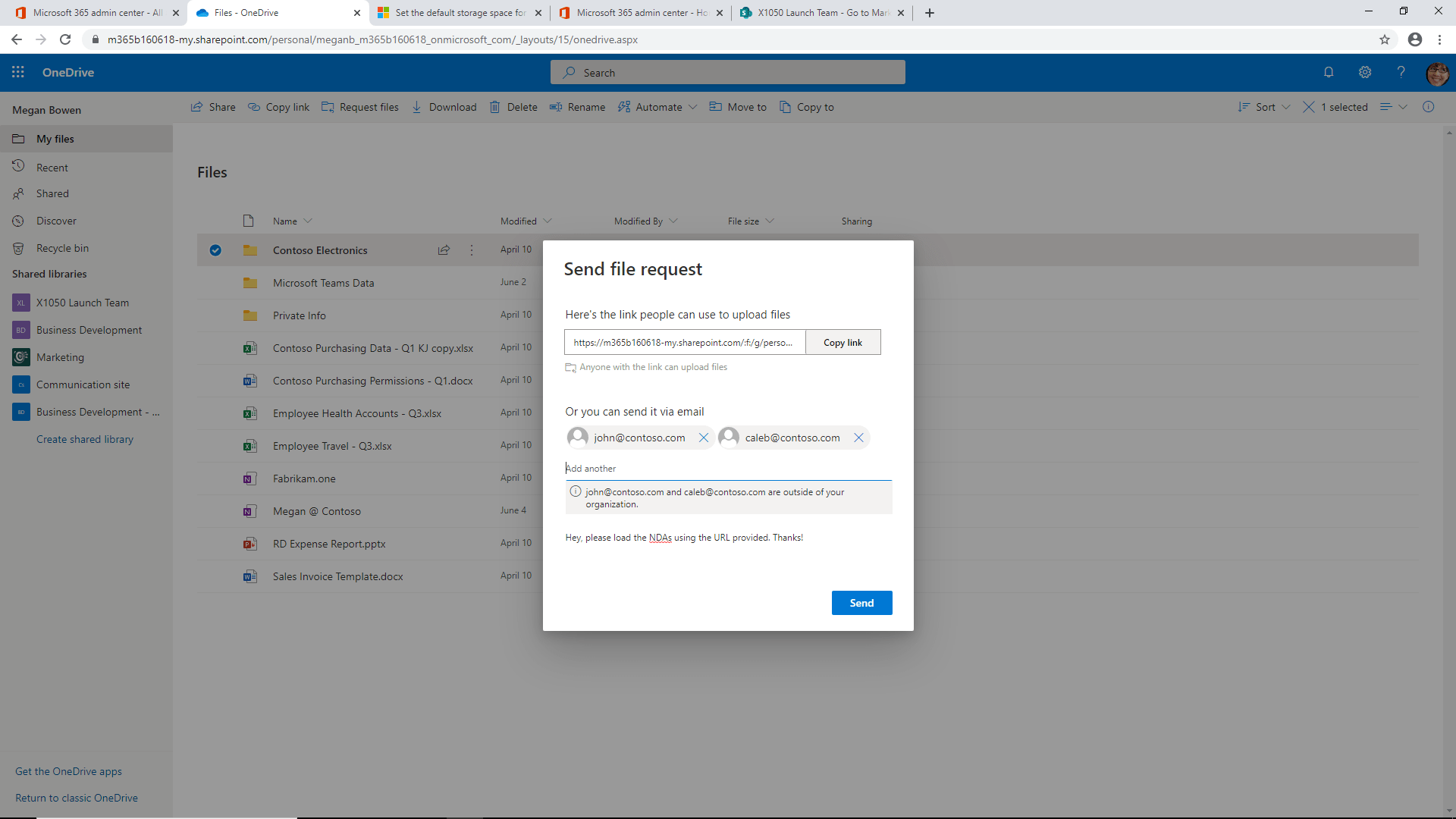
The email sent by this form provides a URL for uploading content to the OneDrive for Business folder. Request files is a great manner to collect and concentrate needed files into a single location for processing. That said, you need to make certain to enable uploads for the binder locations in the request.
Of course, a savvy administrator is thinking, "Hmm, does this provide a way for these users to upload content forever to this location?"
Shown below is the SharePoint admin centre for Policies, Sharing.
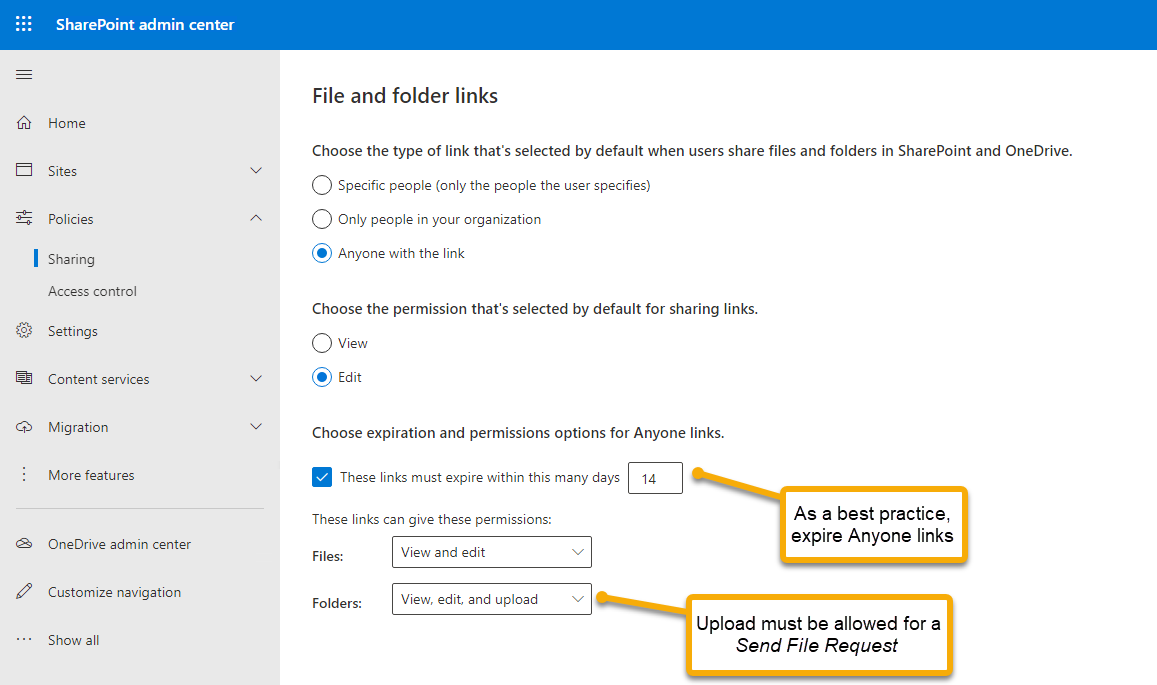
With these settings, yous tin put some boundaries around the ability to upload files to location access given in the Request files invitation. These settings apply to anonymous links sent from OneDrive and SharePoint as well. As a all-time practise, if you permit users to send links to Anyone, which is enabled by default, yous should expire those links. Otherwise, over a menstruation of years, there can be hundreds or thousands of URLs that provide admission to your content making admission control distressingly challenging or incommunicable without disabling anonymous admission altogether.
Folders must be gear up to View, edit, and upload as shown in a higher place to allow users to upload files in response to a file asking.
Synchronization
One of the principal features of OneDrive for Concern is the ability to synchronize files from a user's PC or laptop with OneDrive. With the synch service running, users tin work on files locally, and the changes are sent to the deject. Also, well-known binder locations such as Documents tin can be synchronized, ensuring essential documents are both local and in the cloud. You can easily sync Teams File Repositories as well as SharePoint Document Libraries.
The synchronization service is part of Windows 10, so you exercise not generally demand to download it individually. Users can install the service by clicking Outset and typing OneDrive.
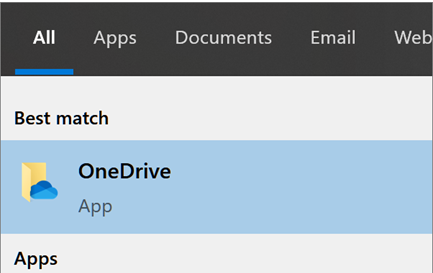
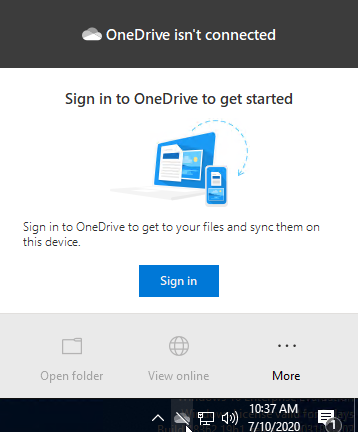
Click on the OneDrive app to launch the setup. OneDrive is then accessible in the taskbar every bit the cloud icon (shown earlier logging in, beneath).
Alternatively, users can enable the client by logging into onedrive.microsoft.com and clicking Sync.
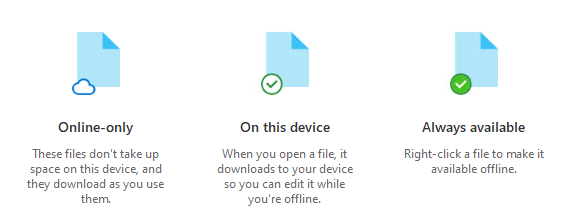
When installed, users can savor the integration of OneDrive with Windows File Explorer. A OneDrive location is visible in the File listing. The OneDrive file listing is unique equally y'all can see if a file is in the deject (cloud icon), local and in the cloud (checkmark), or synchronizing (arrows). Also, when y'all right-click on a file in the OneDrive folder, you tin Share a file, View online, and bank check the version history.
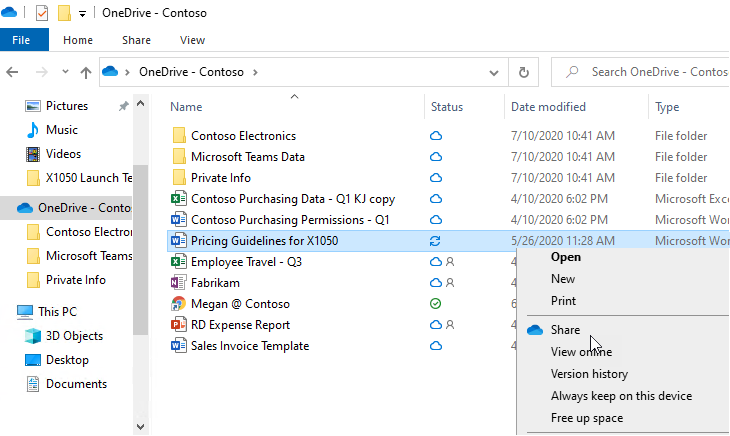
Pay detail attention to the following icons. Shown beneath is a screenshot from ane that appears during the installation of the OneDrive client.
TAKE Note – File on demand enabled by default!
Imagine this scenario. Y'all are working on an important project with several others. A Teams site is used for collaboration. Yous're headed out for an of import meeting with your clients, and a colleague posts several important files to Teams. You've installed the sync client, and you're headed off to the drome, so you think "no worries, I've got them synced to my laptop, and I tin can view them in flight." Aloft, you lot open up your laptop and come across at that place is a deject icon next to files. Clicking on a file, it's not accessible. What happened?
What happened is the Files On-Demand is enabled by default.
Files On-Need marks content that appears in the cloud as cloud-but. A file added to a Teams File Repository will non automatically sync locally. It'due south not available offline until you open up the file, or set the file or folder to Always keep on this device. Optionally, you could besides disable Files On-Demand, which we'll get to in a minute.
For an important file or binder, right-click in Windows Explorer and select Always keep on this device. Users tin as well disable Files On-Demand in the OneDrive customer past opening the client and clicking More->Settings->Settings, and so clear the checkbox that reads Files On-Demand.
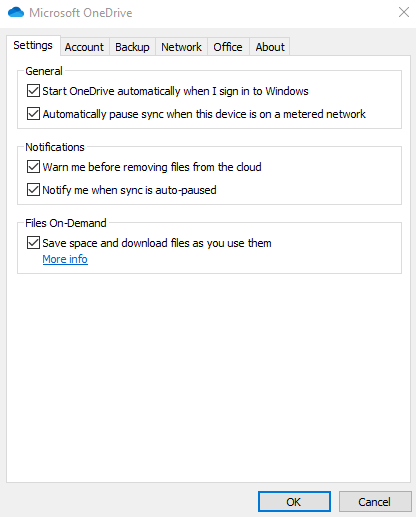
When you clear the checkbox, a pop-up bulletin says that, indeed, the files will download to your PC instead of existence deject-only.
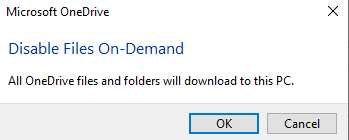
Be advised that as the bulletin above states, if your files in OneDrive for Business concern accept up, say, 1TB, so that 1TB will exist downloaded to your PC. Local storage needs to allow for this. Likewise, administrators need to consider the impact on bandwidth should you disable Files On-Demand for many users at the aforementioned time.
As an alternative, consider instructing users to mark files and folders they want to e'er be available offline "E'er available on this device" using Windows File Explorer equally previously discussed. Then you can keep Files On-Demand enabled to preserve bandwidth as only the designated files and folder will exist permanently synched, while those you open, will be temporarily synched. All others will reside in the cloud.
Using Policy
For small businesses, administrators tin can manage OneDrive for Business effectively with the OneDrive for Business organization administration panel. Larger organizations volition exist interested in using policy. The policy system for Microsoft and Function 365 is considered the most efficient way to manage many settings including those for OneDrive for Business concern. Policy-based assistants provides administrators control, scale, repeatability, and flexibility.
Policy automation tin can be a complicated topic and breaks into different scenarios depending on your network architecture and configuration. For those with on-premise Active Directory environments, yous manage policy via SCCM or Azure AD Domain Services.
If your surroundings is cloud-only (pregnant, yous are not using domain controllers locally), using Microsoft'due south InTune service lets you deploy the OneDrive sync service to desktops using the Microsoft Endpoint Manager admin center.
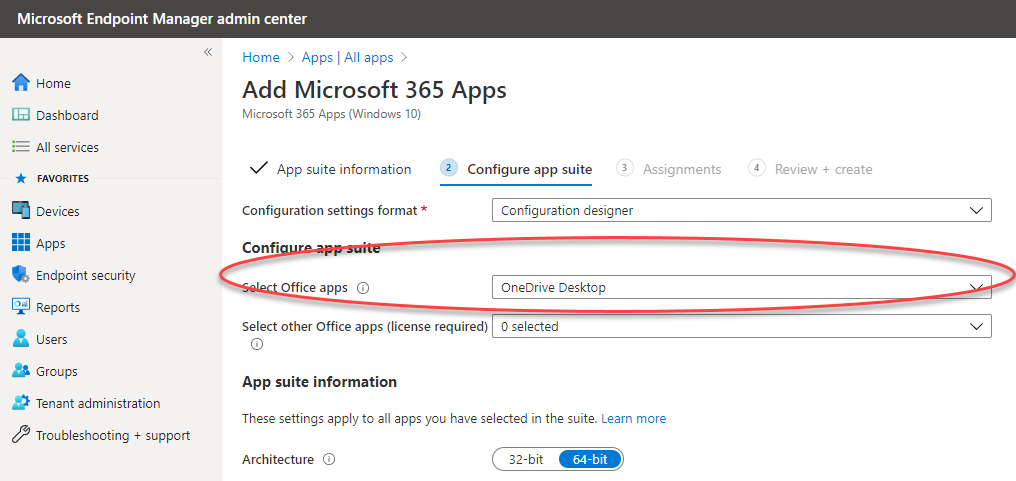
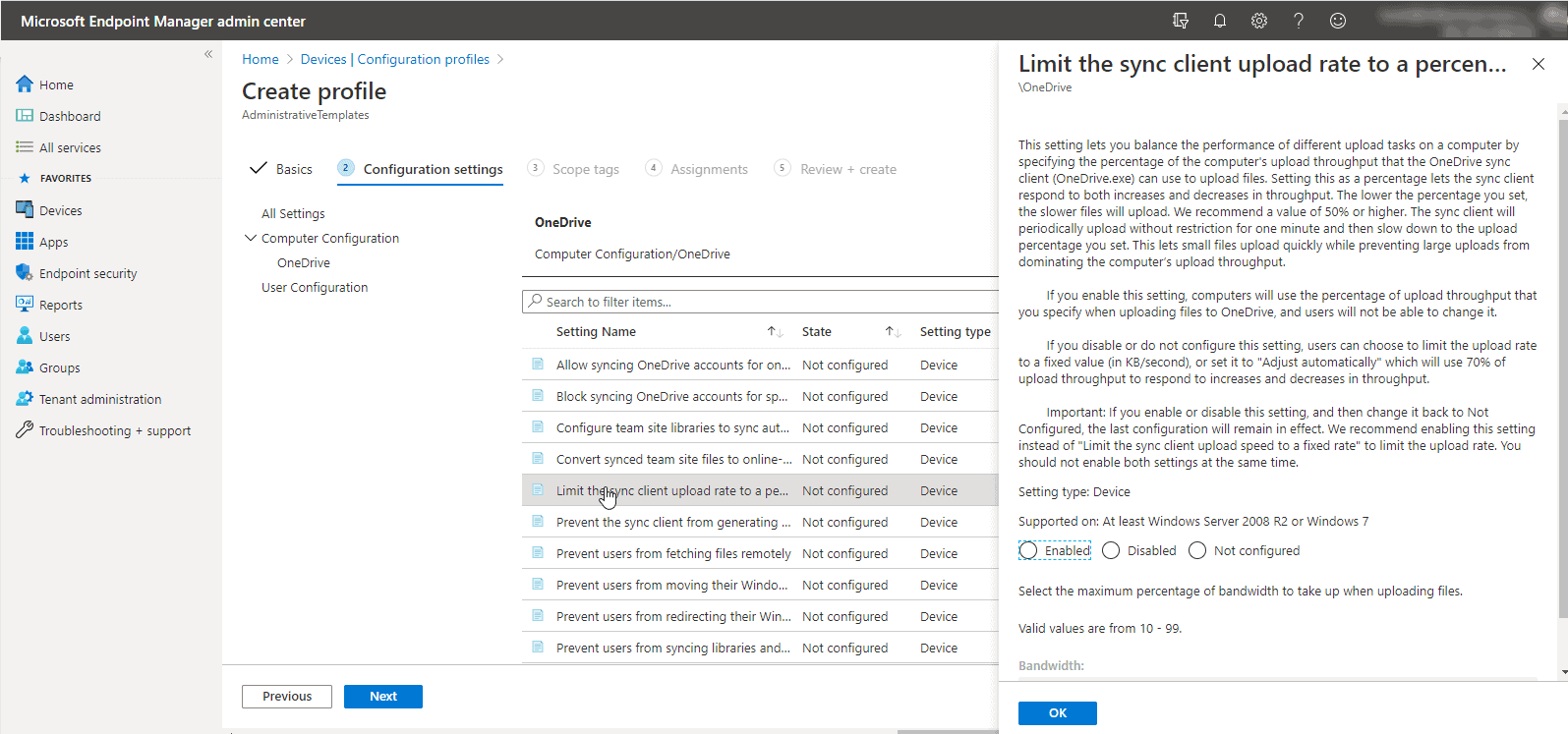
You can also create and apply profiles to users that control OneDrive behavior. Shown below is a policy profile limiting the client upload rate to a percentage of available bandwidth. This one of many possible settings to control OneDrive policies in Microsoft Endpoint Manager.
Previously, yous saw how you can limit sharing with anonymous users to members of a specific security group. Similarly, you tin can employ dissimilar policy profiles to dissimilar security groups.
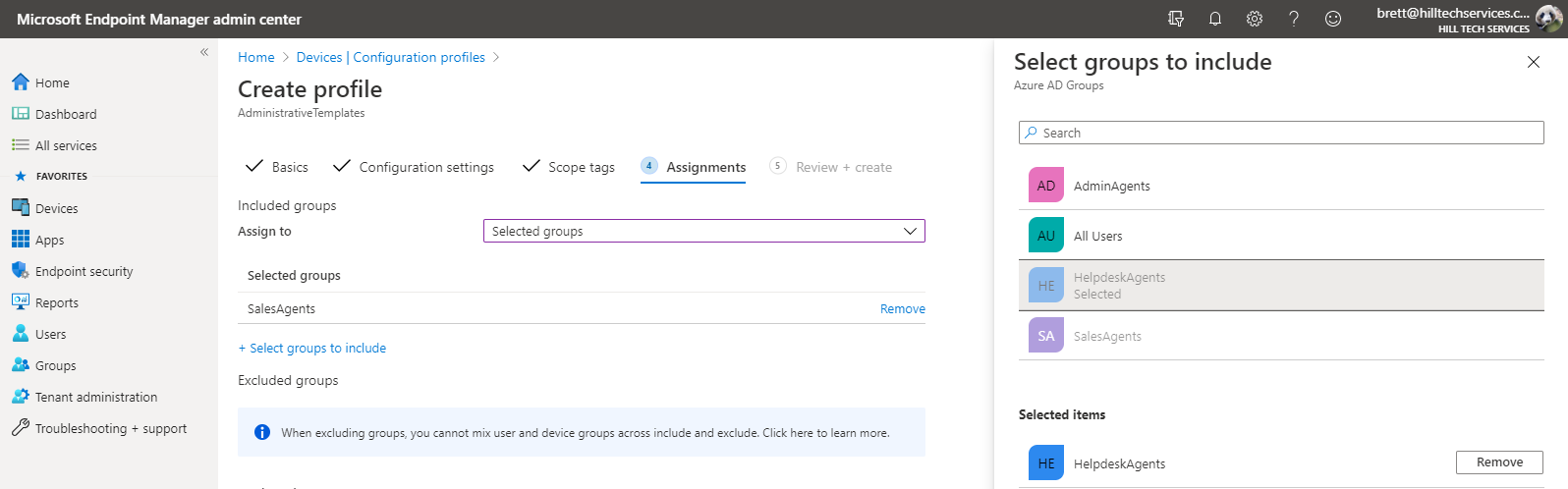
In this style, you manage the behavior of OneDrive and many other aspects of your deject service by membership in security groups. It's easy to imagine uses for this practice with a group for New Hires, Legal-Review-Squad, Brotherhood Partners, Vendors, or other typical roles with differing needs in a decorated organization.
Network Impact
In regards to OneDrive, you want to be thoughtful about bandwidth consumption in your company, especially on the initial deployment of OneDrive for Business. More than than 1 visitor has had problems with essential business services becoming sluggish when hundreds or even thousands of newly deployed OneDrive for Concern sync clients start downloading content at the same fourth dimension. Files On-Need, every bit discussed earlier, helps significantly to reduce the initial bandwidth hit every bit files located in the cloud are not automatically downloaded to clients when enabled.
Known folder moves (discussed next) can besides impact network operation past automatically uploading users' local folders to the cloud when the client is deployed.
To help manage network impacts, the OneDrive sync customer has bandwidth controls built-in. For a small business, yous may desire to adjust these settings on each users' system. Right-click on the OneDrive for Business sync customer, then click Settings->Network to run into the settings.
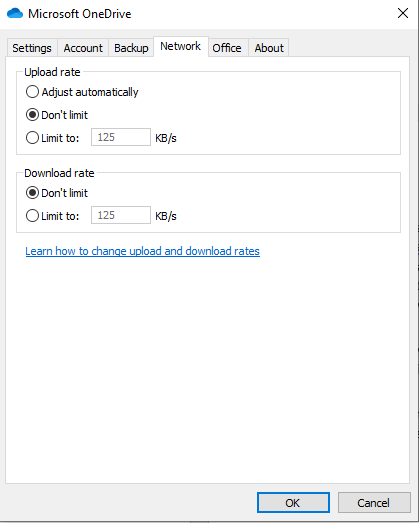
In a larger concern, you can utilise policy to push button the desired settings, including the ability to mark OneDrive network traffic with QoS settings.
Known Folder Moves
Finally, a feature chosen Known Folder Moves is of keen involvement to administrators as information technology can assist reduce support desk calls and ease users' transitions to new computers when replaced or upgraded.
Every bit you probably know, specific folders in Windows, such as Documents, Desktop, and Motion pictures, and others are unique. These are "known folders" as they are in the same location in the file system on every Windows operating system.
OneDrive includes a characteristic where known folder locations are synced to OneDrive for Business concern. When a user needs a file in one of these locations and their PC is not available, they can admission it from any device, including a mobile device that has an net connection. As well, when a user moves to a new PC or laptop, all the previous documents, images, and important files are online and can easily be synched back to the new device.
Known Binder Moves can be enabled in the sync client by clicking on Setting->Fill-in->Manage Backup.
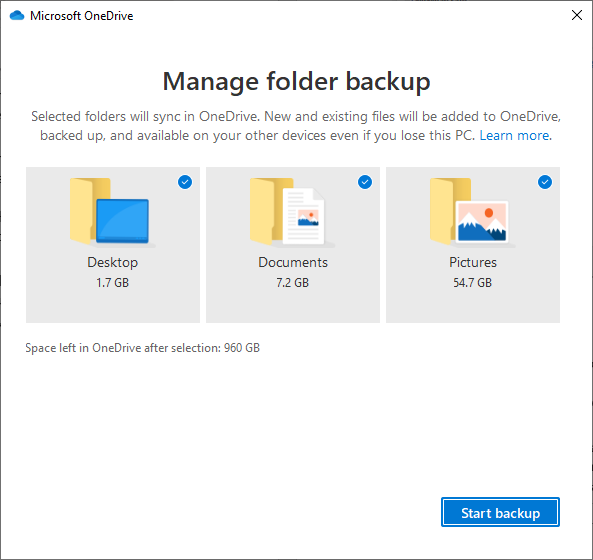
Of course, y'all can too use policy with the methods previously discussed. Should you decide to whorl this out, be mindful of bandwidth impacts and network performance, all that content will be uploaded to the cloud.
Summary
OneDrive for Business is an exceptionally useful service. In this article, we've discussed many of the key considerations, benefits, best practices, and capabilities of OneDrive for Business organization then y'all can effectively manage the service for users. A capable administrator volition understand the business use cases for sharing as well equally the network impact of OneDrive for Business, and be familiar with how to administer the service including using policy to enforce the desired settings for your Business.
When set up, users will bask cloud admission to essential files, including their Desktop, Document, Pictures, Team sites, and other files of importance, assuasive them to share content rapidly and work locally or collaboratively.
Of course, Microsoft is continuously updating OneDrive for Business, and then as a terminal tip, bookmark the Microsoft official OneDrive blog to go along upwards-to-engagement.
Source: https://www.altaro.com/microsoft-365/onedrive-business-tips-tricks/
0 Response to "Shorten Folder Name for Upload on One Drive"
Postar um comentário